Conway's Game of Life: Complexity From Nothing
Four simple rules. An infinite grid. From this: gliders, replicators, and structures complex enough to compute anything computable. It is a universe in miniature.
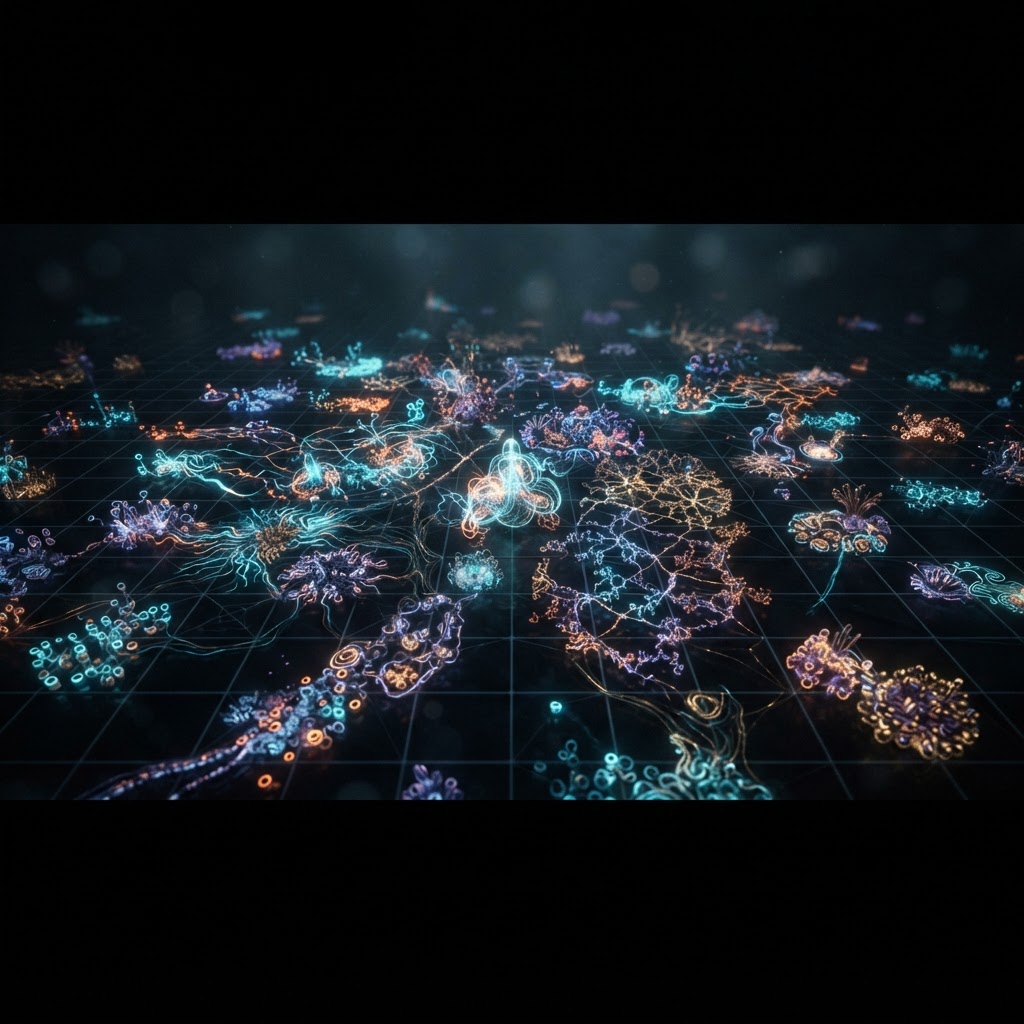
The Rules
John Horton Conway devised the Game of Life in 1970. A grid of cells, each alive or dead. Each generation: (1) a living cell with 2 or 3 live neighbors survives; (2) a living cell with fewer than 2 neighbors dies of underpopulation; (3) a living cell with more than 3 neighbors dies of overcrowding; (4) a dead cell with exactly 3 live neighbors becomes alive. That is it. No other rules. No exceptions.
Emergent Complexity
From these four rules emerge stable structures (still lifes), oscillators (patterns that cycle), and most remarkably, gliders — patterns that move across the grid. From gliders, researchers built logic gates. From logic gates, a complete computer. The Game of Life is Turing-complete: anything computable can be computed within it, given enough space and time. This is the central theme of Math & Algorithms: profound complexity arising from trivial foundations.
The Question of Life and Self-Replication
In 2013, researchers constructed a self-replicating pattern in the Game of Life — a structure that produces a complete copy of itself. This raises genuinely disturbing questions: if complexity and self-replication can arise from four mechanical rules operating on a grid, what does this imply about the emergence of biological life from chemistry? The Game of Life does not answer this. It makes the question impossible to dismiss.
Implications for Physics and Consciousness
If a sufficiently complex Game of Life system is Turing-complete and self-replicating, could it support structures with something analogous to experience? The question connects directly to the Simulation Hypothesis: if our universe is computational, its "rules" might be no more complex than Conway's — and no less generative.
Theories & Experiences(0)
No theories yet. Be the first to share.