The Double-Slit Experiment
A single particle fired at two slits somehow passes through both — until you watch it. The experiment that broke classical physics.
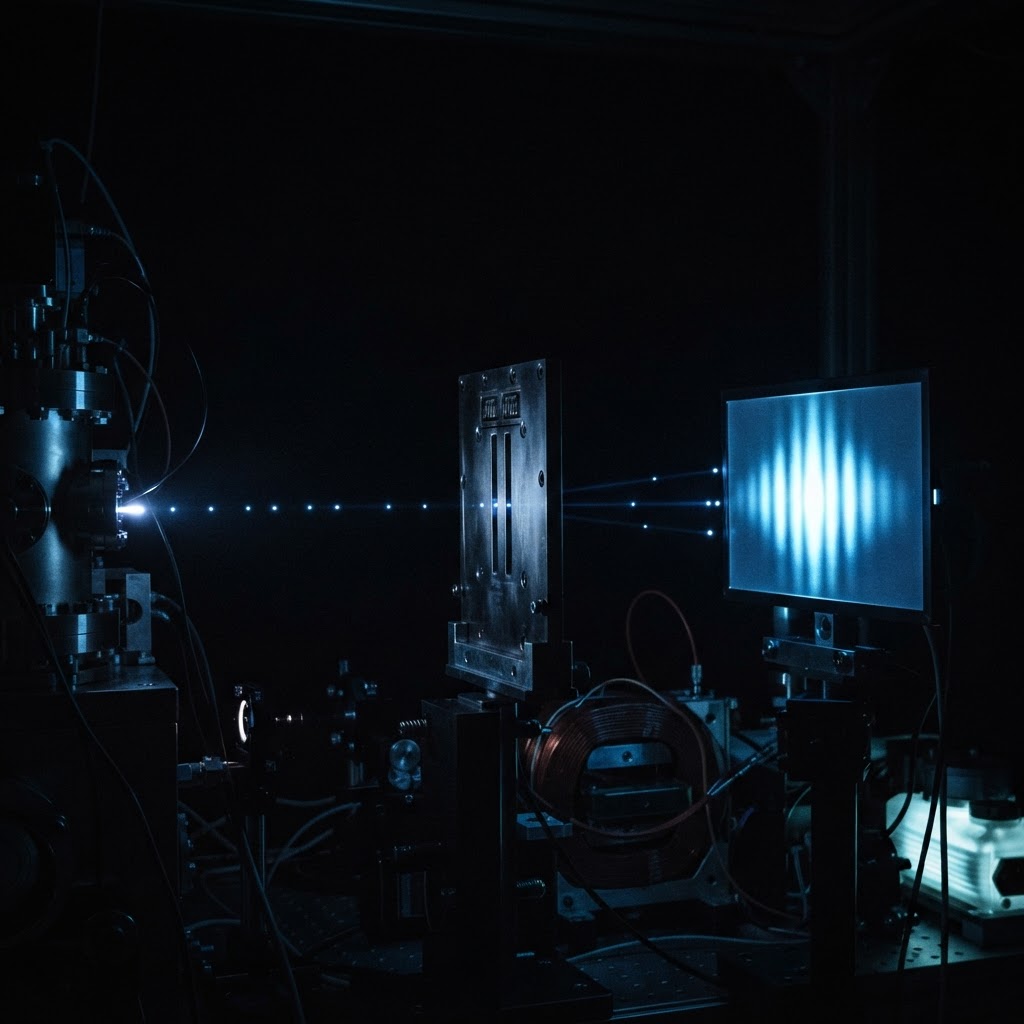
The Experiment
Fire electrons one at a time at a barrier with two slits. Logic dictates each electron goes through one slit or the other and lands in one of two bands on the detector screen behind it. Instead, the electrons build up an interference pattern — the signature of a wave passing through both slits simultaneously.
The Observer Problem
Place a detector at the slits to observe which one each electron passes through, and the interference pattern vanishes. The electrons start behaving like particles again, landing in two neat bands. The act of observation collapses the wave function. This is the same phenomenon explored in Fabric of Reality — where measurement and reality are fundamentally entangled.
What It Implies
Particles exist in a superposition of all possible states until measured. Reality, at the quantum level, is probabilistic — not deterministic. The particle does not secretly travel one path while we are not looking. It genuinely has no definite path until observed. This is not a limitation of our instruments. It is the nature of matter itself.
Why Physicists Still Argue About It
The double-slit experiment is fully explained by quantum mechanics — but what quantum mechanics means remains contested. Does the wave function represent reality, or just our knowledge of it? The debate has split physicists into incompatible camps for a century, with no resolution in sight.
Theories & Experiences(0)
No theories yet. Be the first to share.