The Many-Worlds Interpretation: Every Quantum Event Splits Reality
The interpretation that takes quantum mechanics completely literally — and concludes that every possible outcome of every event actually happens.
Hugh Everett's Heresy
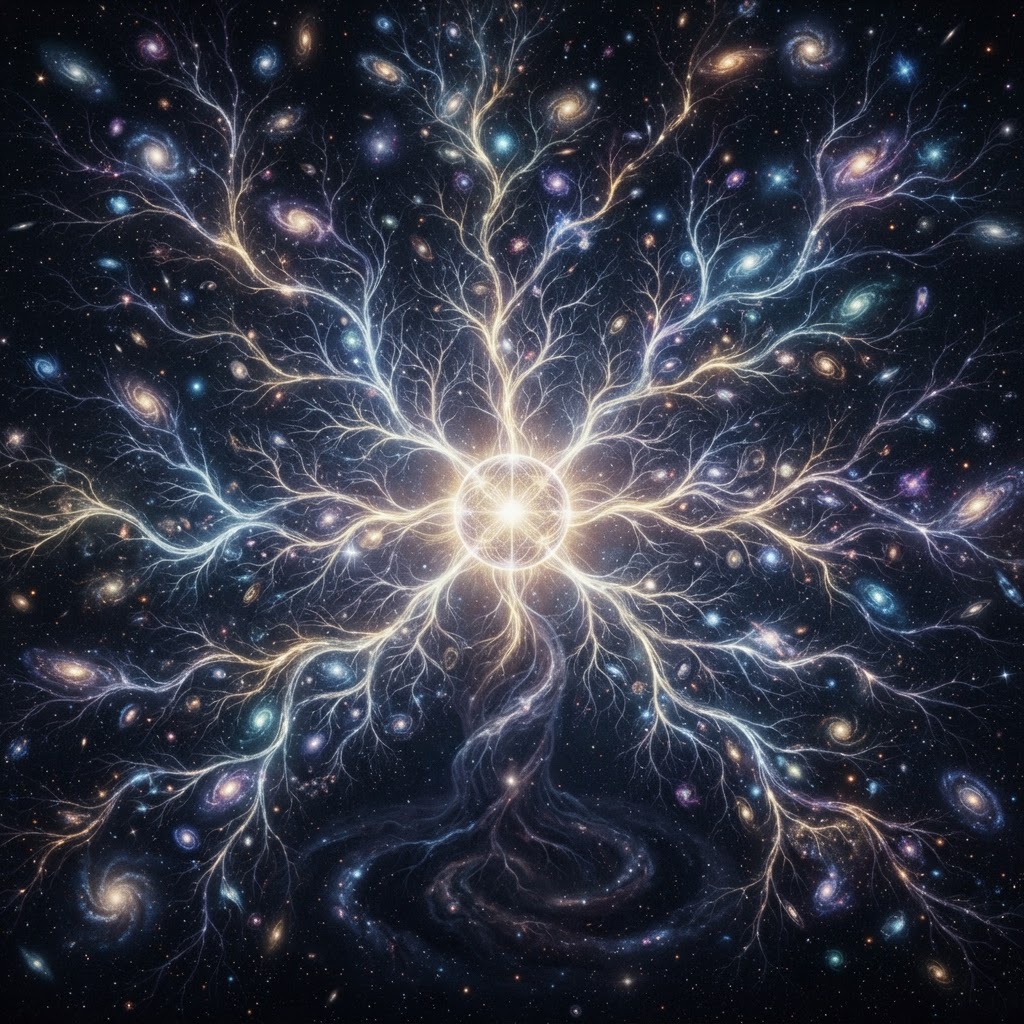
In 1957, Princeton graduate student Hugh Everett III proposed a radical solution to the measurement problem in quantum mechanics. Rather than wave function collapse — the mysterious process by which quantum superpositions resolve into single outcomes — Everett suggested that every possible outcome occurs, each in a branching parallel universe. There is no collapse. The wave function never stops being a wave function.
What "Branching" Actually Means
When a radioactive atom decays or does not, the universe splits: one branch where it decayed, one where it did not. You — and your entire observable universe — exist in only one branch, unaware of the others. The branches do not interact and are mutually inaccessible. This connects to the fundamental weirdness examined in the Double-Slit Experiment and the broader structure of The Fabric of Reality.
Why Physicists Take It Seriously
Many-Worlds is the favored interpretation among quantum computing researchers because it naturally explains why quantum algorithms work — they perform computation in parallel across branches. It is also mathematically the most parsimonious: it adds nothing to the equations of quantum mechanics. It simply takes them at face value. The cost is ontological: an uncountably infinite number of parallel universes.
The Problem of Probability
The deepest challenge for Many-Worlds is explaining why quantum events have the probabilities they do. In a universe where all outcomes occur, what does it mean to say one is "more likely"? The Born rule — which gives quantum probabilities — must be derived from the branching structure itself. Whether this derivation is successful remains the most actively debated issue in foundations of quantum mechanics.
Theories & Experiences(0)
No theories yet. Be the first to share.