Quantum Entanglement
Two particles separated by light-years instantly mirror each other. Einstein called it spooky action at a distance — and he was right to be disturbed.
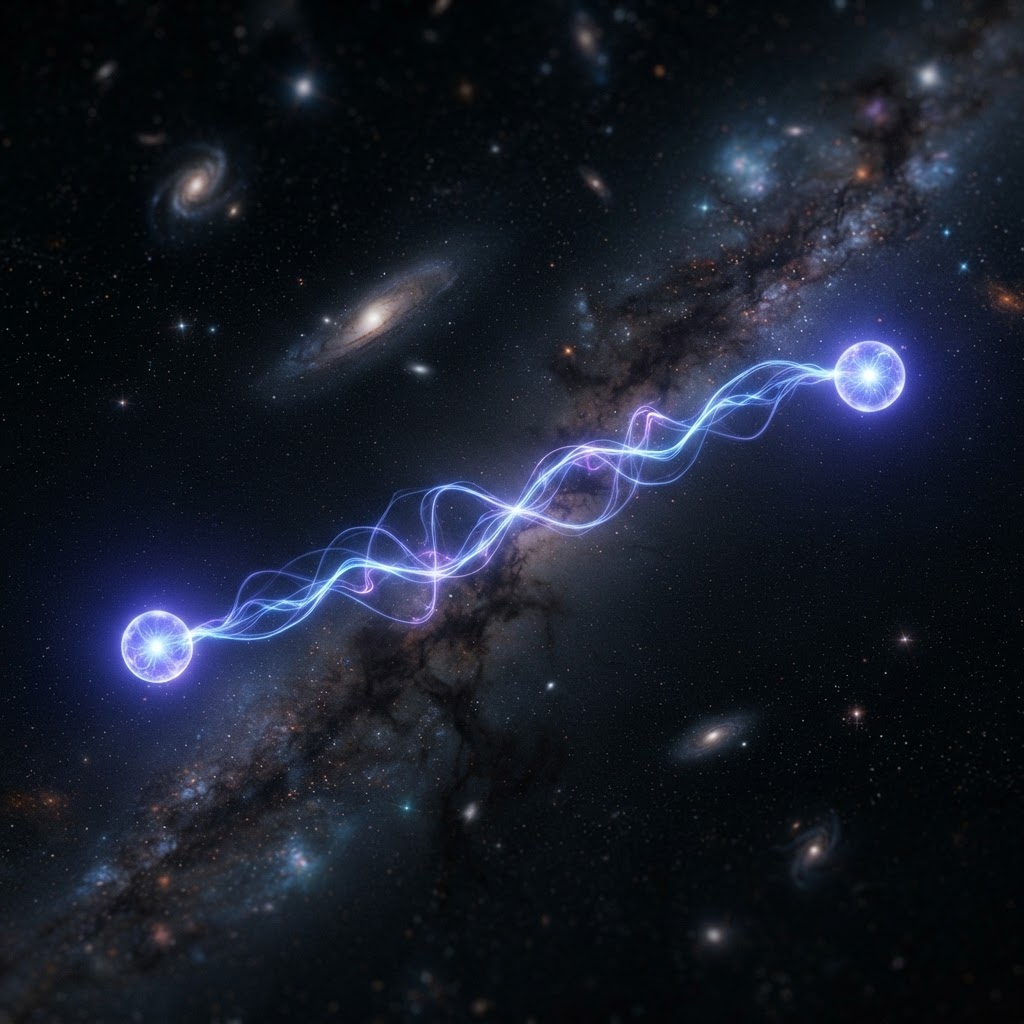
What Entanglement Is
When two particles interact in the right way, their quantum states become correlated — entangled. Measure the spin of one and you instantly know the spin of the other, no matter how far apart they are. The correlation is not explained by pre-existing hidden values. It is a genuine non-local connection.
Bell's Theorem and the Death of Hidden Variables
Einstein believed entanglement implied "hidden variables" — that the particles had predetermined outcomes we simply could not see. In 1964, John Bell devised a mathematical test to distinguish hidden variables from true quantum non-locality. Subsequent experiments, culminating in Alain Aspect's work in the 1980s and loophole-free tests in 2015, ruled out hidden variables decisively.
Does It Allow Faster-Than-Light Communication?
No — and this is the cruel punchline. The correlation is real and instant, but you cannot use it to send information. The measurement outcome on your end is random. You only discover the correlation when you compare results with your partner through a classical channel. This is a recurring theme across Fabric of Reality: nature teases you with impossibilities that turn out to be just barely possible.
Applications
Entanglement is not merely philosophical. It is the foundation of quantum cryptography, quantum computing, and quantum teleportation of information states. The "spooky" phenomenon Einstein dismissed is now the most valuable resource in next-generation technology.
Theories & Experiences(0)
No theories yet. Be the first to share.