The Quantum Zeno Effect: How Observation Freezes Time
Continuously observe a quantum system and it never evolves. The watched pot really doesn't boil — and the physics behind this is stranger than the metaphor.
Zeno's Arrow and Quantum Mechanics
The ancient Greek philosopher Zeno argued that a moving arrow is, at any instant, motionless — so motion is an illusion. The Quantum Zeno Effect is the modern incarnation of this paradox with actual experimental confirmation. In quantum mechanics, frequent measurement of an unstable particle can significantly slow or halt its decay. The more you look, the less it changes.
The Mechanism: Wave Function Collapse and Continuous Measurement
When you measure a quantum system, you collapse its wave function back to its initial state. If measurements occur faster than the system can evolve, each measurement resets the clock. The system has no time to decay between observations. Decoherence — the process by which quantum systems lose their superposition by interacting with the environment — is effectively being constantly reversed. This links directly to the Observer Effect and broader themes in The Fabric of Reality.
Experimental Confirmation
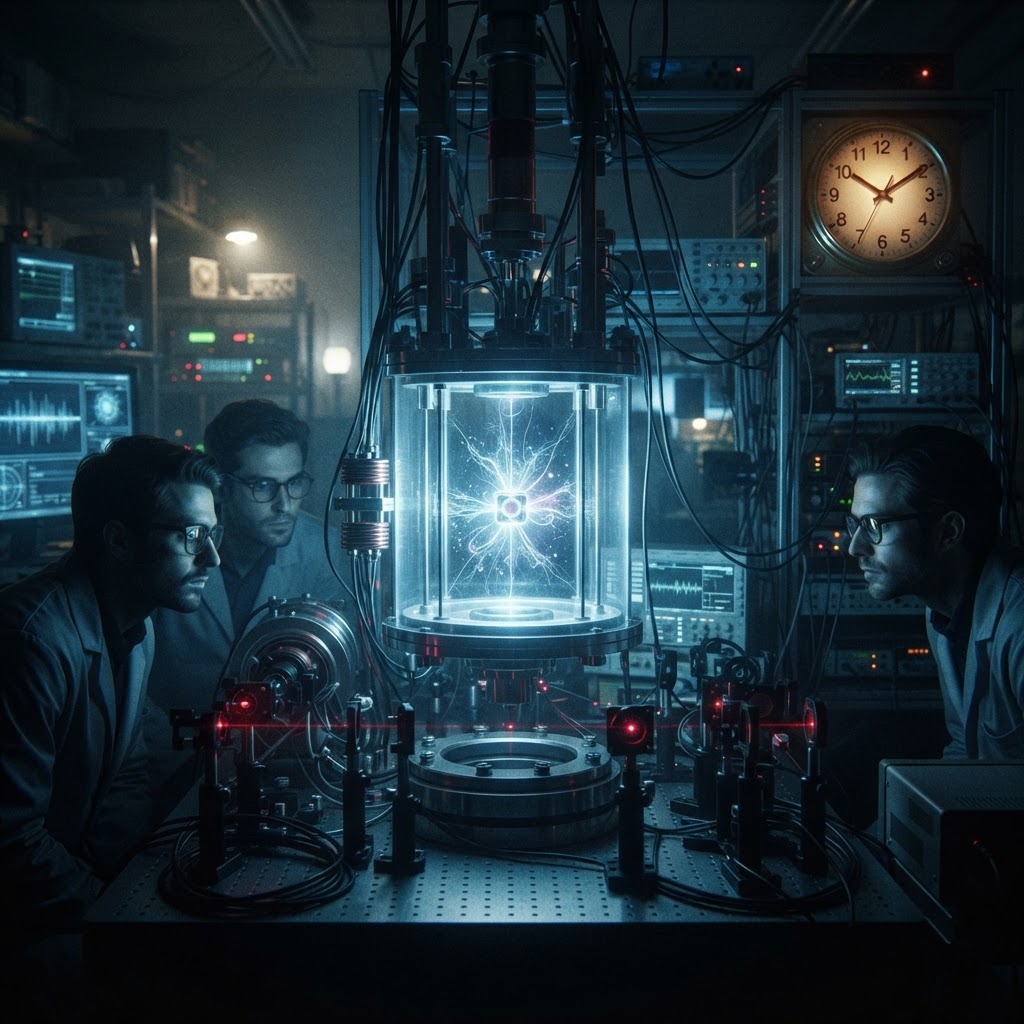
In 1989, Wayne Itano and colleagues at NIST demonstrated the Quantum Zeno Effect experimentally using beryllium ions. Repeated measurements during a transition suppressed the transition rate by a factor proportional to measurement frequency. The effect is real, reproducible, and now applied in quantum computing to extend qubit coherence times.
The Anti-Zeno Effect
There is a twist: under certain conditions, frequent measurement can accelerate decay rather than freeze it — the Quantum Anti-Zeno Effect. The arrow of time at the quantum level is not simply governed by duration. It is governed by the rate and nature of interaction with the observer. Whether the universe itself "measures" its own quantum states — and what that would mean — remains an open question.
Theories & Experiences(0)
No theories yet. Be the first to share.